Using the differentiable microlensing package microlux, we analyze two highly degenerate events. Accurate derivatives enable efficient gradient-based inference, and for the Point/Finite sub-degeneracy in KMT-2025-BLG-1314, HMC mixes more robustly than traditional MCMC.
In this paper, we apply our JAX-based differentiable microlensing code microlux to two new events, KMT-2025-BLG-1314 and KMT-2025-BLG-1392. Both events are highly degenerate, so this work is also a test of differentiable microlensing inference on realistic posteriors.
The key methodological point is that microlux provides accurate derivatives, which makes gradient-based inference practical for binary-lens modeling. The main advantage of Hamiltonian Monte Carlo (HMC) here is its higher efficiency in correlated, high-dimensional parameter spaces. In KMT-2025-BLG-1314, this leads to much better mixing than a conventional ensemble MCMC sampler for the Point/Finite sub-degeneracy within the planetary solutions.
The most interesting result is the final figure below. For KMT-2025-BLG-1314, chains initialized at the Planet Close Point and Planet Close Finite modes converge to a consistent posterior under HMC, while the traditional MCMC runs remain initialization-dependent.
Astrophysically, the favored solutions correspond to \(\log q \sim -3.5\) for the planetary branch of KMT-2025-BLG-1314, \(\log q > -1.5\) for the binary branch, and \(\log q \sim -1.3\) for KMT-2025-BLG-1392.
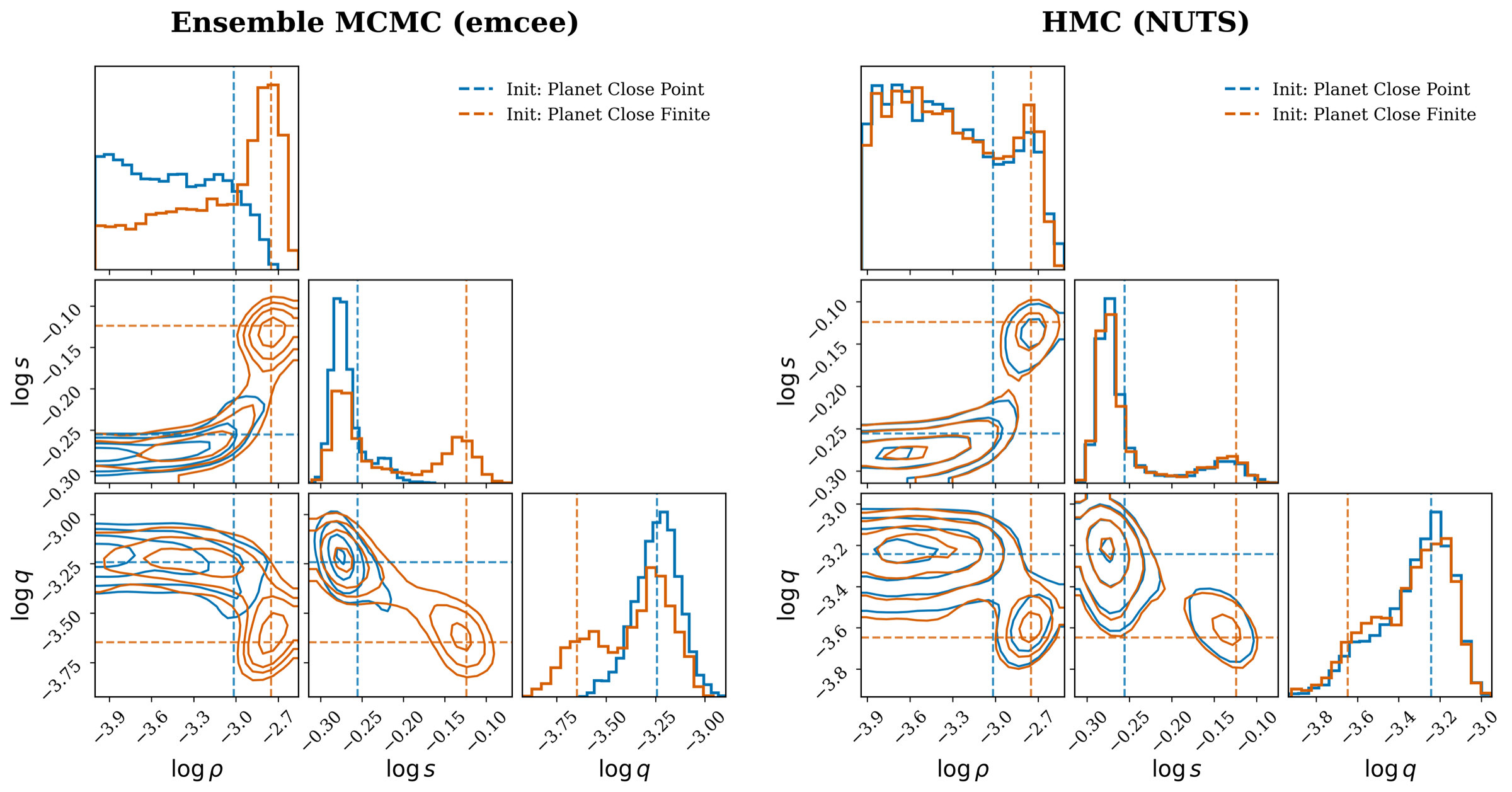
Caption: Comparison of a traditional ensemble MCMC sampler (left) and HMC (right) for KMT-2025-BLG-1314. The two runs are initialized at the Planet Close Point and Planet Close Finite modes. With gradients from the differentiable model, HMC converges to a consistent posterior, while the conventional sampler remains strongly initialization-dependent.
This work has been submitted to Research in Astronomy and Astrophysics (RAA).